
- MUSIC TO DREAM BY:
- Music to Love By
- Meditation
- Oasis
- Reverie
- Gliders In Motion
- Osmose 4
- Pensando en la inmortalidad ...
- Archives Jam Sessions
- Saxophonics Vol. 1
- Spirited Beats
- Angel Music to Dream By
- Poesie en Musique
- Magical 80s
- Space-Time Out
- Music to Dream 2
- Odd Ones
- Reflections in a Cathedral
- Magical 70s
- Maui Postcard
- MetaMorphantasy
- ExPERIMENTAL
- Sound Bath One
- Elan Vital
- Voices No Words
- I Am With You
- Reverie Music to Dream By
- Pillars of Light
- Unearthed Flutes
- Notes Above Land
- French Archives II
- Antivirus Music
- Saxoridoo
- Rainbow Dreamwalker
- Corona Insola
- In My Dreams
- Bindu
- Ambient Zeitgeist
- Keep Calm and Breathe
- See You Up There
- Music for Quiet Times
- Birds Dreaming
- Astral Dreams
- Mainly Mental
- Energy Archives
- Dervish Wish
- Tantric Sax
- Concerts 2019
- Intemporel
- Music to Dream By 562
- Moonlight-Suite
- Archives Portasound-1981
- Live in Concert Europe 2018
- Osmose III
- AndroGene 2018
- Eternalia
- Rue de la Gaite 70s
- Sarasvati Planet Ariel
- Astral Cathedral
- 1985 Kula Blackhole
- Confidential
- Never Mind
- Dream Stars
- Rainbow Remix
- Ascend Descend
- Au Mage Manege
- 1978 Delirium GRM
- Planet Air
- Space Shift
- Interfrequence
- Music Pour le Reve et l'Amour
- Meditation in the Forest
- Reallusions
- Galactica Electronica
- Lazy Lizard
- Osmose 2
- Chillout India
- Spirit Dancer
- My Sax, my Love
- Flowing Dreams
- Flute for the Soul
- Serenity
- Endless Breath
- Open Like a Flute, Vol 1+2
- Yo Yo A New Man
- Yo Yo Homme Nouveau
- Chansons d'Esprit
- Osmose
- Le Temps des Moissons
- Osmose
- Interfrequence
- An Evolutionary Music
- We Know Each Other Somehow
- Open Like A Flute
- Musique Pour le Reve et l'Amour
- Le Temps Des Moissons
- French Archives 1977-80 (4LP)
- Intemporel
- Nuits Blanches au Studio 116
- Head Voices
- French Archives Vol. II
Ariel Kalma is the kind of musician that collectors live their lives to find at the bottom of a dollar record bin, and the kind who fellow musicians hope to become. He is a composer who worked on the periphery of a fringe movement, whose early adherents have recently seen an explosion in popularity...
- Vivian Hua, redefinemag.comReviews of some of Ariel Kalma's albums
& interviews
French Archives Vol II - 4-LP box
French Archives Vol I 1977-80 - 4-LP box
We Know Each Other Somehow - CDs and LPs
An Evolutionary Music - CDs and LPs
Open Like A Flute - CDs and LPs
Osmose - CD and LP
Le Temps des Moissons - CD and LP
Chillout India - CD
Spirit Dancer - CD
Reallusions - CD
Review of Ariel Kalma's work
French Archives 1977-80 (4-LP box)
English translation (original in Italian):
We promised it, so, after the last "Rue De La Gaité" we return to talk about Ariel Kalma and we do it on the occasion of the aforementioned "French Archives 1977-1980", a monumental and beautiful publication on quadruple vinyl dedicated to the artist , edited and curated by the Italian label Black Sweat Records....
Full review here (in Italian)A lavish 4-LP box set, now emerging in Black Sweat's cradling embrace, draws from previously unreleased recordings from one of Ariel Kalma’s most creative rich periods. Divided under
four headings - Sarasvati Planet Ariel, Planet Air, Ascend Descend and Astral Cathedral,
these works were conceived as both autonomous works, sculpting distinct sonic environments, as well as for group therapy sessions for healing, trance and relaxation....Stretching from harsh abstract electronics, sublime done, and rippling melodic works for synthesizer, organ, and other acoustic instruments, but across these three LPs, Ariel Kalma strays considerably closer to the efforts of ambient Krautrock pioneers like Tangerine Dream and Popol Vuh....
Absolutely stunning on every count.
Unquestionably one of the most beautiful and important releases of the year.
Full review here.Ariel Kalma’s 70’s drone music is getting a 4xLP box set reissue, so get ready to rock that Shavasana
Ariel Kalma’s 70’s drone music is getting a 4xLP box set reissue,
so get ready to rock that ShavasanaIf you aren’t already familiar with the work of French sound artist Ariel Kalma, check out a few of these descriptors: ambient, new age, drone, Jon Hassell, 70’s, India, SHAVASANA.
Now that you’re right and excited after all those sexy words, you’re going to be even more titillated when you hear that a massive box set of Kalma’s recordings from the 70’s is coming out November 17 on Italy’s Black Sweat Records. This 4xLP set should give you plenty of time to try not to sleep on that soft, welcoming yoga mat you just brought home from the studio. Just don’t forget to turn the record(s) over!
Full review here.
By Liberation by Olivier Lamm(French)
Le Temps des Moissons (1975)
Peu de disques publiés à compte d’auteur ont acquis un statut aussi vénérable que celui-ci.....
Interfréquence (1980)
Chef-d’œuvre a minima, Interfrequence n’avait pas vocation à trouver la gloire, puisque ses vignettes n’ont pas été enregistrées pour un label commercial mais pour le catalogue du label d’illustration Editions Montparnasse 2000.....
An Evolutionary Music Original Recordings : 1972 - 1979 (2014)
Compilée à partir de plusieurs dizaines d’heures d’enregistrements personnels, cette anthologie d’inédits fait curieusement un parcours très complet dans la jeunesse musicale de Kalma.....
Full review here
Interviews with Ariel Kalma
electronicbeats.net
Ariel Kalma speaks to Bing & Ruth's David Moore about the strength of limitations
Ariel Kalma and David Moore have never met, but they have a lot in common. They’ve both been inducted into the RVNG family (which, full disclosure, includes Electronic Beats staff writer Mark Smith of Gardland), they both work with ambient structures and classical instruments, and we’re pretty sure that neither would want to classify their music as “ambient” or “classical.” - Full interview here
We made a skype with Ariel Kalma, this French composer from space
If America has Terry Riley, France has Ariel Kalma . Composer precursor of electroacoustic music planante, this saxophonist who began his career as a stage musician alongside Adamo, Jacques Higelin or Richard Pinhas and who was hanging out in the GRM studios between two transotic journeys in India, did not yet met with the esteem and commercial success he deserved. - Full interview here
BOMB magazine by Jefre Cantu-Ledesma & Maxwell August Croy
Never one to eschew opportunity, French-born Ariel Kalma has been following serendipitous roads to productive musical and spiritual beginnings since the 1970s. Rarely remaining in one place for long, Ariel’s nomadic existence led him to encounters with the Dagar Brothers in India, Pierre Henry’s INA-GRM in France, Don Cherry and the Arica School in New York, and finally, to Australia where he currently resides with his family. From playing sax in 1960s Parisian rock ‘n’ roll and jazz bands, crashing in the catacombs of the Cathedral of St. John the Divine in 1970s New York, or fashioning his own Dream House (despite having never experienced La Monte Young’s MELA Foundation installation) in a tiny flat in Paris, Ariel’s brush strokes across the canvas of experimental music are wide, deep, and textured. His harmonic trajectory has given rise to a vast catalog of cacophonous glee and psychedelic excursions devoid of pretense. As if guided by cosmic forces, Ariel’s evolution continues to into the present. - Full interview here
Redefinemag.com by Vivian Hua
Ariel Kalma is the kind of musician that collectors live their lives to find at the bottom of a dollar record bin, and the kind who fellow musicians hope to become. He is a composer who worked on the periphery of a fringe movement, whose early adherents have recently seen an explosion in popularity, despite spending the last few decades in relative obscurity. In his youth, Kalma traveled the world experimenting with a vast array of instruments and genres, from free jazz and minimalism to experimental electronic music, fusing them into a completely unique sound that was all his own from the beginning. - Full review here
The New Noise by Emilio Mannari e Maurizio Inchingoli (Italian)
Viaggio nelle viscere della terra – Le musiche dal mondo di Ariel Kalma
Approcciarsi alla musica dell’artista francese, di stanza in Australia da tempo, è operazione che richiede con tutta probabilità un trascorso di un certo tipo, poi spiegheremo meglio perché. Intanto va detto che, pure grazie all’italiana Black Sweat Records (Al Doum & The Faryds, Maurizio Abate, J.D. Emmanuel), ci è stata data la possibilità di conoscere meglio l’opera di un avventuriero che di storie da raccontare ne ha parecchie, così l’intervista più sotto può venire in nostro soccorso. - Full review here
Coolaboration with Ariel Kalma
New Age Rising – a collective illumination compiled by Frosty
Reviews of concerts
New York - Experimental electronic musician Ariel Kalma collaborated with Robert Lowe
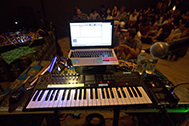
Ariel and Robert wrapped up a short tour in support of their "FRKWYS 12" album, hitting NYC on August 8 at Artists Space Books & Talks, a show that was presented byIssue Project Room. Lowe's hauntingly processed vocals combined perfectly with Kalma's multi-instrumental accompaniment (keys, programming, sax and more) into a transportive whole that had the room pindrop quiet. Pictures from this rare performance are in this post.
Full review here
 |
 |
 |
 |
 |
 |
New York - musicandliterature.org
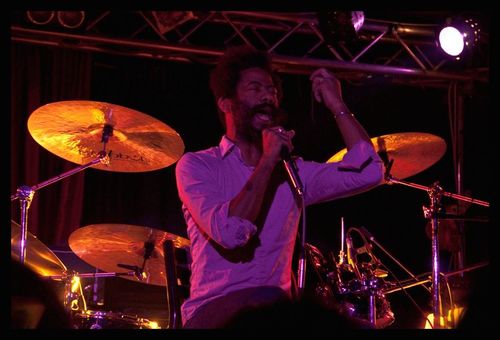
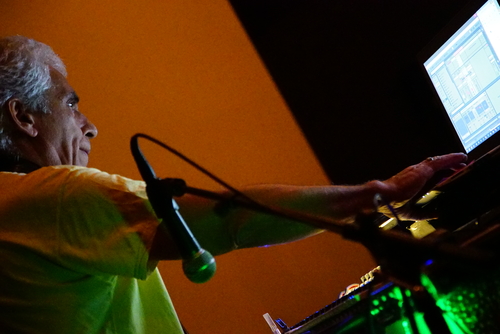
Together the two explore and update some of the major musical developments from the last four decades or so—from drone and ambient music, so-called "world" music, and aspects of free jazz and New Age to intercultural, improvised minimalism and ideas taken from musique concrète and acousmatic production. But equally meaningfully, in the face of this bewildering melange of currents and styles, they also shine a light on the immediacy of the creative process, illumining the systems working through us as a group, connecting us, binding us, generating something out of us. Chaining us together through overlapping rings of experience, partnership could be seen as a systemic spiritual unfurling. In the realm of musical collaboration, it could yield interesting results. "Multiversal" musician and sonic thinker Ariel Kalma shares a space and an experience with Robert Aiki Aubrey Lowe, otherwise known asLichens. Together and in the live setting, their music becomes something more akin to biomass. Every note, every sound, every idea starts with a well-defined gesture, distinct to both of the performers; eventually well-formed soundscapes bubble to the surface and spill over. Full review here
 |
 |
Vancouver - Robert Aiki Aubrey Lowe & Ariel Kalma at Ukranian Cultural Centre